Influence of Saddle Fit on Locomotion and Biomechanics of the Horse
The utilisation of horses as ridden animals starts with two athletes, a pairing of a human and a horse (Clayton and Hobbs, 2017). In most equestrian riding disciplines, the pair is connected through different equipment. The most prominent one is the saddle, which as an extrinsic factor helps the rider to distribute the pressure of their weight evenly and communicate different cues to the horse, aiding the nonverbal communication that must happen for the pair to work together seamlessly (Greve and Dyson, 2013). As helpful as saddles can be in keeping the rider in the most optimal position on the animal’s back, horses were not biologically designed to carry weight. Therefore, any added weight will affect equine locomotion and biomechanics, with incorrect saddle fit even causing lameness (Bondi et al., 2020). The aim of this report is to delve into this extrinsic factor, which can affect a horse’s predisposition to injury and performance (Hobbs et al., 2014).
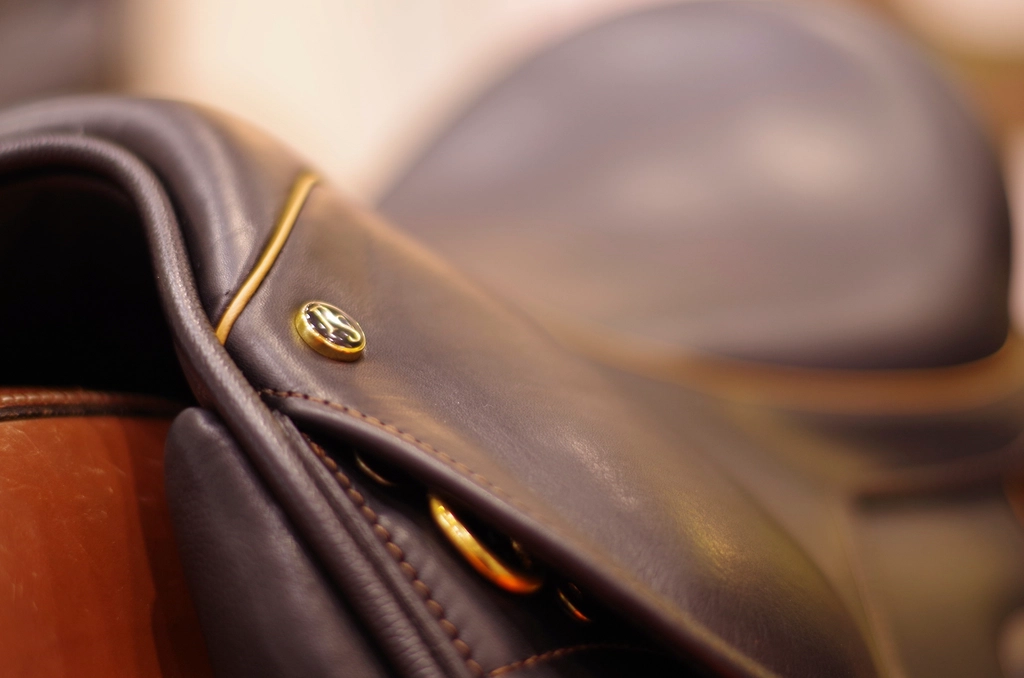
Saddles as an extrinsic factor influencing movement
There are both intrinsic and extrinsic factors that affect the equine athlete, with equipment being a major influencing extrinsic factor (Hobbs et al., 2014). Saddles are in the majority designed with an inflexible tree made out of wood, metal or plastic, on top of which the saddle is constructed. As previously mentioned, saddles having to cater to two users brings its own challenges. Ill-fitting saddles have long been associated with back pain (Harman, 1999; Jeffcott et al., 1999). Different components of saddles affect different points of anatomy, and each can therefore affect locomotion in a distinct manner. Different materials also differ substantially in their pressure distribution properties (Kotschwar, Baltacis and Peham, 2010a, 2010b). The equine sector recognises that for a saddle to fit well, it must evenly distribute pressure, not restrict the movement of either rider or horse, and avoid any points of pressure on the horse’s back, especially the spine (Martin et al., 2017).
An important component in direct contact with the horse’s back is the saddle panel. Panels ensure fit optimisation, thus regulating the horse’s comfort and pain management. Studies comparing standard-width panels to wider panels have shown a decrease in pressure in the cranial and middle areas underneath the saddle, but an increase in the caudal part where the rider’s weight predominantly sits (Martin et al., 2017). With this wider-panel modification, Martin et al. (2017) showed that, alongside the decrease in pressure, range of motion (ROM) increased at the T12–T16 and T16–L2 regions of the back. These increased ROM values were closer to those of unridden horses — meaning closer to unburdened spines, which represent complete and healthy ROM.
Although de Cocq et al. (2009) showed that weight on the back does reduce ROM, this is not to a degree that would impact the horse’s athletic performance, despite the “hollowing” effect it has on spinal posture. It does, however, affect the internal conformation of the vertebral column, changing the internal forces exerted on anatomical structures, with approximation of the spinous processes of the thoracic and lumbar vertebrae. Such posture, especially in the caudal part of the spine where spinal ROM is largest, is damaging, as research has shown lesions of the dorsal spinous processes are most frequent there (Walmsley et al., 2002).
An additional aspect of saddle effects concerns the protraction–retraction phase of the equine forelimb during trot, with the retraction phase increasing in walk and trot to support the added weight on the horse’s back (de Cocq et al., 2009). An increase in strain on tissues during the retraction phase, along with all forelimb joints, increases cumulative contact stress, which in turn increases the odds of osteoarthritis (Buckwalter et al., 2013).
At the other end of the saddle-tree spectrum, treeless saddles have been shown to further increase peak pressure underneath them, which can reduce spinal ROM and affect stride length. Some researchers have hypothesised that treeless saddles are not appropriate at higher speeds of trotting and cantering, as pressure could rise to tissue-damaging values if sustained for a prolonged period (Belock et al., 2012; Martin et al., 2017).
Relevance to the chiropractic practitioner
Given the direct correlation between tissue damage and incorrect saddle fit, the chiropractic professional must be aware of the warning signs a patient may present with in such cases (Haussler, 2010). Chiropractors perform joint manipulation via the manual application of low-amplitude, high-velocity thrusts. This technique moves a segment of the vertebrae or a joint beyond its physiologic ROM, but does not push the affected structures beyond the limit of the articulation (Gatterman, 1995).
Practitioners assess the animal’s body prior to treatment, looking for sensitivity, changes in tone, and tissue reactivity to touch (Veenman, 2006). A consistent reduction in ROM due to ill-fitting saddles will cause strain on the treated animal’s tissues. As holistic practitioners, considering all possible causes of misalignment — including tack mishaps — is crucial (Nankervis et al., 2024). Increased pressure points from an ill-fitting saddle expose tissue to potential injury and contraction. Treatment of a repeatedly aggravated area will only provide mild relief until the original cause of discomfort is resolved (Veenman, 2006).
Once resolved, chiropractic treatment can be of great benefit in restoring previous ROM of vertebral segments and alleviating soft tissue concerns, as the technique promotes blood flow and reduces oedema, pain and joint effusion caused by tissue restrictions (Haussler, 2010).
As previously established, increased peak pressure on back tissues can change equine locomotion, but the animal can still perform effectively with adapted movement patterns — which in turn affect joint biomechanics and angulation, accelerating wear and tear on tissues not designed to endure such force (Harrison et al., 2012). Even after chronic pain caused by ill-fitting saddles has resolved, the body will continue with the same adjusted movement patterns unless disturbed by new neural pathway information.
This has been shown to be provided by chiropractic spinal manipulation, which increases dorsoventral displacement of the trunk, indicating a return of spinal flexibility and increased tolerance to pressure in the thoracolumbar region (Imamura et al., 2008). The adjustments also stimulate systemic changes in neurologic signalling related to pain processing and motor control, allowing the animal to re-establish healthy movement patterns (Haussler, 2010).
An additional nuance that helps a professional build client relationships and provide the best service is recognising appropriate healing times. Standard rest recommendations of up to two days post-treatment reflect the fact that resuming weight-bearing too soon can severely set back the animal’s recovery to optimal movement (Haussler, 2018). It is therefore crucial to discuss an after-care plan with owners. Any animal a chiropractor suspects of having an ill-fitting saddle and compromised biomechanics should be referred to a saddle-fitting professional. Recognising that a holistic approach — and being part of a multidisciplinary team — is key to success is of great benefit to any soft-tissue professional (Nankervis et al., 2024). To uphold their reputation among clients, chiropractic practitioners must remain continuously vigilant for tissue, locomotion or behavioural changes (Greve and Dyson, 2013), as this practice supports early issue detection and reinforces client relationships.
Conclusion
Owners heavily rely on paraprofessionals such as chiropractors to assess potential and future risks to their animal’s health and comfort. Having a basic understanding of how animal tissue responds, and the long-term effects of an ill-fitting saddle, is therefore of the utmost importance to these professionals. An ill-fitting saddle can be a quiet locomotor obstructor, causing significant damage to the animal’s body over time. Because the whole body is connected, even one seemingly minor detail — such as incorrect saddle placement — can trigger a whole-body response, with effects ranging from performance reduction, such as shortened stride length and altered behaviour under saddle, to visibly detectable tissue damage, such as muscle atrophy and reduced ROM of spinal segments. For optimal equine health and movement, saddle fit should always be a priority.
References
Belock, B. et al. (2012) “Comparison of pressure distribution under a conventional saddle and a treeless saddle at sitting trot,” The Veterinary Journal, 193(1), pp. 87–91. Available at: https://doi.org/10.1016/J.TVJL.2011.11.017.
Bondi, A. et al. (2020) “Evaluating the suitability of an English saddle for a horse and rider combination,” Equine Veterinary Education, 32(S10), pp. 162–172. Available at: https://doi.org/10.1111/EVE.13158.
Buckwalter, J.A. et al. (2013) “The Roles of Mechanical Stresses in the Pathogenesis of Osteoarthritis: Implications for Treatment of Joint Injuries,” Cartilage, 4(4), pp. 286–294. Available at: https://doi.org/10.1177/1947603513495889.
Clayton, H.M. and Hobbs, S.J. (2017) “The role of biomechanical analysis of horse and rider in equitation science,” Applied Animal Behaviour Science, 190, pp. 123–132. Available at: https://doi.org/10.1016/J.APPLANIM.2017.02.011.
de Cocq, P. et al. (2009) “The effect of rising and sitting trot on back movements and head-neck position of the horse,” Equine Veterinary Journal, 41(5), pp. 423–427. Available at: https://doi.org/10.2746/042516409X371387.
Gatterman, M.I. (1995) “What’s in a word,” in Gatterman, M.I. (ed.) Foundations of chiropractic. St. Louis, MO: Mosby-Year Book, pp. 5–17.
Greve, L. and Dyson, S. (2013) “The horse–saddle–rider interaction,” The Veterinary Journal, 195(3), pp. 275–281. Available at: https://doi.org/10.1016/J.TVJL.2012.10.020.
Harman, J. (1999) “Tack and Saddle Fit,” Veterinary Clinics of North America: Equine Practice, 15(1), pp. 247–261. Available at: https://doi.org/10.1016/S0749-0739(17)30175-X.
Harrison, S.M. et al. (2012) “Forelimb muscle activity during equine locomotion,” Journal of Experimental Biology, 215(17), pp. 2980–2991. Available at: https://doi.org/10.1242/jeb.065441.
Haussler, K.K. (2010) “The Role of Manual Therapies in Equine Pain Management,” Veterinary Clinics of North America – Equine Practice, 26(3), pp. 579–601. Available at: https://doi.org/10.1016/j.cveq.2010.07.006.
Haussler, K.K. (2018) “Equine Manual Therapies in Sport Horse Practice,” Veterinary Clinics of North America – Equine Practice, 34(2), pp. 375–389. Available at: https://doi.org/10.1016/J.CVEQ.2018.04.005.
Hobbs, S. et al. (2014) “Equine surfaces white paper,” FEI Books [Preprint]. Available at: https://scholar.google.com/citations?view_op=view_citation&hl=en&user=dJHKyh4AAAAJ&citation_for_view=dJHKyh4AAAAJ:roLk4NBRz8UC (Accessed: 29 August 2026).
Imamura, M. et al. (2008) “Evidence-informed management of chronic low back pain with massage,” Spine Journal, 8(1), pp. 121–133. Available at: https://doi.org/10.1016/j.spinee.2007.10.016.
Jeffcott, L.B., Holmes, M.A. and Townsend, H.G.G. (1999) “Validity of Saddle Pressure Measurements Using Force-sensing Array Technology — Preliminary Studies,” The Veterinary Journal, 158(2), pp. 113–119. Available at: https://doi.org/10.1053/TVJL.1998.0334.
Kotschwar, A.B., Baltacis, A. and Peham, C. (2010a) “The effects of different saddle pads on forces and pressure distribution beneath a fitting saddle,” Equine Veterinary Journal, 42(2), pp. 114–118. Available at: https://doi.org/10.2746/042516409X475382.
Kotschwar, A.B., Baltacis, A. and Peham, C. (2010b) “The influence of different saddle pads on force and pressure changes beneath saddles with excessively wide trees,” The Veterinary Journal, 184(3), pp. 322–325. Available at: https://doi.org/10.1016/J.TVJL.2009.02.018.
Martin, P. et al. (2017) “Effects of Large Saddle Panels on the Biomechanics of the Equine Back During Rising Trot: Preliminary Results,” Journal of Equine Veterinary Science, 48, pp. 15–22. Available at: https://doi.org/10.1016/J.JEVS.2016.08.006.
Nankervis, K. et al. (2024) “Experiences of Interdisciplinary Working from the Perspective of the Society of Master Saddlers Qualified Saddle Fitters,” Animals, 14(4). Available at: https://doi.org/10.3390/ANI14040559.
Veenman, P. (2006) “Animal physiotherapy,” Journal of Bodywork and Movement Therapies, 10(4), pp. 317–327. Available at: https://doi.org/10.1016/J.JBMT.2006.03.004.
Walmsley, J.P. et al. (2002) “Impingement of the dorsal spinous processes in two hundred and fifteen horses: case selection, surgical technique and results,” Equine Veterinary Journal, 34(1), pp. 23–28. Available at: https://doi.org/10.2746/042516402776181259.